Showing posts with label Bible. Show all posts

Wednesday, May 18, 2011

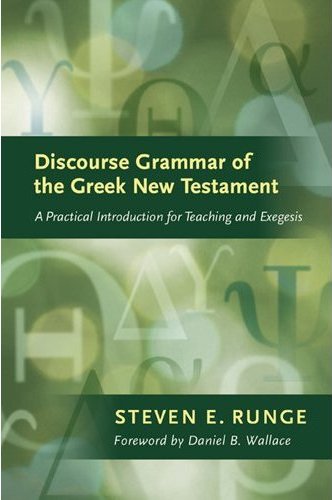
Discourse Grammar of the Greek New Testament

I have never been this excited to read a book on Greek.  It is my new book soulmate (yes, books have souls).  If you know anything of Greek, do pick this book up.  Maybe a review will come some day.

Saturday, November 13, 2010

Thomas Schreiner's Galatians


So it's finally here, Schreiner's commentary on Galatians in the Zondervan Exegetical Commentary on the New Testament series (ZECNT). With a sermon on Gal 4:21-31 coming up, I immediately put this to work. Here are some of my scattered thoughts about the commentary:

1) Very stylish cover and page layout (I'm not bothered by the small margins). There are on average five footnotes per page (often more), where he interacts with specific authors on grammatical/historical points. There are a few excurses on the obvious Galatians flashpoints (justification, works of law, faith in/of Christ, Lev 18:5, law of Christ, Israel of God).

2) For the introduction, three sentences are given to authorship, six pages to the letter recipients (prefers a South Galatia readership), five pages to the situation Paul is addressing, three pages on the issue of empire in Galatians, and sixteen pages on the opponents' background and beliefs (Jewish? Pagan? Etc.). Other issues are addressed as well, but these were the most interesting to me.

3)I'm not a 'Paul guy,' but the bibliography and author index seem pretty well-rounded to me, although Campbell's The Deliverance of God is a surprising omission.

4)The frequent text boxes, shaded areas, and clear divisions help the reader track the discussion. The graphical layout and structural outline of the text do a great job at tracking the argument, which is essential for a letter like Galatians.

5) The concluding "Theology in Application" sections were often helpful, while not overly stimulating.

6) When talking about Greek, very little jargon is used (I couldn't find any "epexegetical, resumptive, protasis-apodosis, etc."), and any jargon used is explained, ex. "adversative conjunction 'but'" (p. 348).

8) The closing 'Themes in Galatians' contains great summaries on....themes...in Galatians.  You see, there's that emphasis on clarity this series holds to.

7) I'd compare this with the BECNT series.  While ZECNT may not be as detailed as BECNT, it matches it with clarity and a holistic approach.  And the theology/application emphasis in ZECNT isn't found in BECNT or even Pillar.

My impression: The focus on the flow of the argument (which the series obviously strives for) is commendable and Schreiner does it well. While some will surely miss in-depth, scholarly discussion on every individual word, Schreiner gives you Galatians as a whole. Pastors would do well to pick this up, and scholars would do badly to pass it by.
Wednesday, October 20, 2010

2 Maccabees reflection--almost

So what does one do when they fail to complete an academic writing assignment? Throw it up on a blog! And so I follow this rule that I just made up.

This was supposed to be a reflection on 2 Maccabees, but the deadline was a little to quick for my writing habits. Yet, instead of locking this up in a mausoleum, I set it free on the net. So here it is.

Perhaps the most emotionally gripping passage in 2 Maccabees is chapter seven with the persecution of the mother and her seven sons. Yet, in the midst of the vivid descriptions of the barbarous torture of the family, the theological theme of atoning martyrdom is brought up. While the references to atoning martyrdom in this passage are brief, I will argue that the concept arose out of the Jewish experience of persecution and the defilement of the temple. In this brief reflection the first part will examine the material in 2 Maccabees (especially chs. 5-7), and then conclude with a discussion of the role of atoning martyrdom with Jesus in the New Testament gospels.
The context for the development of atoning martyrdom begins in 2 Maccabees 5 with the invasion of wrathful Antiochus from Egypt to Jerusalem in 5:11. After his great slaughter, he, led by Menelaus, entered the temple and seized the temple vessels and votive offerings (5:16). While the text does not explicitly say, it can be reasonably inferred that this action caused the temple to be defiled. Following this, the narrative aside (5:17-20) makes it clear that the nation was under God’s judgment, which also implies that they were defiled because of sin.
Turning to 2 Maccabees 6, the Hellenistic culture is violently forced upon the Jewish nation. This includes the debauchery of the people in the temple, and the forbidden elements offered on the altar. If there was any question of the defilement of the temple from the previous chapter, it is obvious that the nation is defiled, thus rendering it unable to offer means of atonement for sin and purification.

End of text


Maybe someday I'll finish it, but I'm not holding out hope.

Monday, February 1, 2010

Thoughts from Mark

So we had our first lecture on the actual text of Mark. Here are some issues I want to pursue further (not necessarily limited to Markan studies):

-The 'fresh perspective of Jesus,' which deals with Jesus' anti-empire stance and mission. How much of the New Testament is a critique of Rome and empires in general?

-The role of literary criticism as opposed to historical-critical biblical study. Does literary criticism of the gospels undermine or unnecessary ignore the historical references/issues?

-And my personal favorite: the New Testament's use of the Old Testament.

Tuesday, February 10, 2009

I'd like to get back to that wonderful topic of evangelism. However, I'm going to approach evangelism from a different angle. And the angle might be such that I may not even tangentially touch on evangelism. But it's okay; God is good. Let's get at it.

In a conversation between two professing Christians, one fields the question: "I repented and asked Jesus to save me, so why bother reading your Bible all the time and stuff like that? What else do you need?"

Whoa


After hearing about that conversation (and especially that question), I almost collapsed on the floor, Jenga-style. On the one hand, I felt like I had never heard such blasphemy in my life (I've calmed down since then and have retracted the accusations of blasphemy). Come on! Who doesn't want to read their Bible!? That's the dumbest thing I've ever heard.

Then I stopped. The scales came off, and I realized that that question is simply one of the best questions I have ever heard. One half of me screams "Burn the heretic!" (as previously demonstrated). But the other half marvels at and sympathizes with the question and the question-er. Here's why:

The question itself "Why bother to read the Bible and (insert other Christian practices) when being saved is all that we need?" is so foundational and significant that it deserves its own individual treatment. Then, have that question be asked by a well-churched, well-seasoned, professing Christian and you have a whole new knot in a tangled piece of string. If that question was posed in a vacuum, or even by a non-Christian, then the answer is seemingly simple. But a senior Christian asking that question shows some major holes in their foundational beliefs.

So I've labored the point long enough. And since I've labored over making that point long enough, I'm going to post this little diddy. But, friendly reader, what do you think about this person's question? What does this question reveal? How would you respond? We can't really address the individual in question (pun, unintentional), but we can look at the question and work from there.

Thursday, October 23, 2008

Bible War


So the ESVSB has landed, and what a ruckus it has caused. On one hand it is quite exciting, on another hand it can cause rebellious types like me to roll their eyes a little bit. Do we need an extra 700 pages of Bible? Do we need glossy reconstructions of the Jerusalem temple? So, with stone-faced determination I went and employed my "less is more" ethic. I went and bought a Bible.


That's what I'm talking about.

Friday, August 15, 2008

Bible colleges are in big trouble

How's this for an OT/NT survey class?

Thursday, June 19, 2008

Nice Product Placement


I have figured that if I can't teach professionally, then I'd like to give advice professionally. And if I can't give advice, then I'd like to recommend things. In order to practice, I'm going to recommend something that I have enjoyed that I think others would enjoy as well. Today I recommend the IVP Reference Collection. This is a collection of the fantastic dictionaries and commentaries that IVP has put out over the years (Dictionary of Jesus and the Gospels, Dictionary of Paul and His Letters, New Dictionary of Biblical Theology [my favorite] etc.), all available on a single CD-ROM. While I have only had this collection for a few days now, I have already lost a few hours of sleep by scanning the contents of these wonderful reference works. A personal bonus for me was that I could read Dr. Jonathan Lunde's article on Heaven and Hell in Dictionary of Jesus and the Gospels! Okay, I'm going to stop blabbing so that you can go out and order your own copy today. 17 amazing reference works for $120!!

Wednesday, June 11, 2008

Sum_thin' Bibluh-kal

18 When he takes the throne of his kingdom, he is to write for himself on a scroll a copy of this law, taken from that of the priests, who are Levites. 19 It is to be with him, and he is to read it all the days of his life so that he may learn to revere the LORD his God and follow carefully all the words of this law and these decrees 20 and not consider himself better than his brothers and turn from the law to the right or to the left. Then he and his descendants will reign a long time over his kingdom in Israel.

Deuteronomy 17:18-20


I find this portion of Deuteronomy to be worth reflecting on because it is a strong reminder of the purpose of Bible study. While I am not in a position to speak about the devotional life of contemporary Christianity (nor do I want to), I will be bold to say that this pericope could prove to be a fitting corrective for many who take the devotional life seriously (even I could learn something from it).

Once brought into office, the king was to write out the law. Whether this means Deuteronomy or the whole Pentateuch, I don't know, but the point remains: the law of God defines your kingly office; The word of God is above you and has authority over you. And not only will the king note the law, but he will know the law as well (wow, this sounds like a sermon outline). Day after day, the king will burn this law into his retinas. And for what?? Simply put: revere God, be obedient, and be humble. What blows the mind is that these three effects can not be separated from one another. How can a person grow in reverance to God and not be obedient or show humility to others? James condemns that idea. Or can one accurately be humble toward others while actively slandering God by their actions? This type of Bible study was to result in obedience to the two greatest commandments: love for God and for others. The king of Israel was to act out the law perfectly by having God's transforming word continually in his view, so that he could echo the praises of God in Psalm 119--

12 Praise be to you, O LORD;teach me your decrees. 13 With my lips I recount all the laws that come from your mouth. 14 I rejoice in following your statutes as one rejoices in great riches. 15 I meditate on your precepts and consider your ways. 16 I delight in your decrees; I will not neglect your word.

If I may, I would like to single out one aspect of my own experience that fits in well with this topic. I was engaged in an intense study of Numbers for a class on the Old Testament. Throughout the book of Numbers, Israel bats 1.000 when it comes to blowing it with God: rebellion, complaining, apostasy, idolatry, etc. And time after time God brings in the big stick of wrath and punishes the evildoers. Now, having grown up in the church, stories of God's wrath weren't unusual to me. Yet, reading over these stories for myself made me pause. These stories are depressing! After some time and time, I came to two conclusions about these stories: 1) God was having some major mood swings, so He frequently overreacted. So He may have judged a lot, but He apologized soon afterwards; or 2) Sin is terribly evil and offensive to God, and Israel were getting what they deserved. As much as I didn't like it, option #2 rang true. However, it wasn't until a few weeks later that the truth of God's hatred for sin came home to me. I saw myself deserving only fire from heaven and for the earth to open and swallow me. I finally saw that I was no better than the wicked, faithless people of Israel. And there I was, laying in bed, being given breath after breath, and not being utterly destroyed by God's righteous wrath. If God's boot would have come down on me at that moment, or any other moment in my Godless existence, God would have been right to do so. It is in those moments of surrender, of a damned felon who begs with a dead heart for life, that the cross creates a new being, a new goal, a new conception of the world. God is supreme, and everything of Him is worth giving one's life for. Loving one's neighbor is effortless because the greatest effort was given on my behalf. Obedience is a joy because perfect obedience was carried out with joy--even to death.

Monday, June 9, 2008

With Knowledge Comes...

Before I start to complain, I need to say something first. I love(d) being a Bible major. I never really had any interest in anything before I became one. Except pogs and USC football, but their glory faded quickly. I didn't really think that God was that great until I became one, despite being a Christian since I was five years old. I didn't really think about big or important things until I was a Bible major. God used Biola to wake me up, and for that I am grateful.

Okay, on to the point of the post.

75 units of Bible have messed me up. That's a big statement, and the rest of this post will qualify it and make it more palatable.

Church is a struggle for me. I love it. I love the people. I love the word. I love God. Woot church. However, everything I hear at church, every sermon and worship song, has to pass through this dense jungle called KNOWLEDGE. This jungle grows and feeds off of the 75 units of Bible classes, the 8,000+ pages of reading, and an incalculable amount of blog posts and Bible-themed discussions that have accumulated in my head over these three years. This 'jungle' makes it difficult for biblical truths or words of praise to penetrate my inner being because the truth must fight for its life and prove its worth to me. All my other collected thoughts surround the incoming truth and pummel it until it displays some true grit and is then admitted into my Spiritual Truth Receptacle Zone (STRZ). Allow me to illustrate an instance or two of what happens every ten seconds on a Sunday morning:

The worship band is playing a nice mid-tempo rocker that was probably written around 1990-1991. Sounds innocent enough. A line in the song describes Jesus as the "Lamb of God." That line catches my eye. "Uh oh," I mutter, "here we go again." [What follows is what goes on in my head]

"Ok, 'Lamb of God.' That comes from John 1 and Revelation 5. Typical of John's style, he isn't literally saying Jesus is a lamb, but Jesus' significance is tied up in how the lamb functioned in Jewish society, especially in the religioius sphere. It probably relates to the sacrifical lamb...what's that fancy name for it. Oh, the paschal lamb. It relates to Jesus being the sacrifice for sins. Cool. [Goes back to singing the worship song] But wait, what is the background for John the Baptist calling Jesus "the lamb that takes away the sin of the world" ? Did he know Jesus was going to die on the cross? I don't think so. I know Carson lists 9 different options as the background to this title. What were they? Maybe he's a conquering lamb that will judge the wicked. That fits with John's expectation of the Messiah as seen in the Synoptics. Or...what if the Gospel of John isn't historical? What if John made this story up just to make Jesus look cooler than he is? Everyone thinks John was written late, so maybe I'm being naive in thinking John is accurate. Dang it. [Goes back to singing, although with a tinge of hesitation] Okay, wait, chill out dude. What would Carson say? How would I know??!! Maybe if I read that book on John by Richard Bauckham, then I'd know. But I must know. Well, everyone knows John couldn't have been written in the 2nd century because of that one papyrus, and no one thinks it was influenced by Gnosticism. So Bultmann and Baur are dismissed. Okay, but what if John was written in stages, and different layers were added to make Jesus more miraculous? Does that mean the Jesus Seminar was right? Am I only singing to the Christ of Faith, not the Christ of History? Then God can't exist, but he has to! The Kalam Cosmological Argument proved it! But that also depends on one's idea of causality, and in an open metaphysic I have to take more things into account. I knew I should've studied philosophy. Oh, the song is over. Time to sit down. [Takes seat, wipes brow, and prays] End.


In this example 'the jungle' was the winner. It is a miracle that I ever learn anything at church, much less pay attention to what is going on during the service. I don't have any deep reflections or conclusions on this strange phenomenon, but it is something to think over and examine more.