Wednesday, June 8, 2011

Napoleon Won


We're nearing the 7th anniversary of the release of Napoleon Dynamite, in my opinion a third-rate comedy stuck in first gear for eighty-two minutes, yet it still managed to suck in an undeserving $47 million (thanks IMDB).  Since the movie challenges Star Wars and The Sandlot in the realm of pop culture ubiquity, a plot recap would be both hopelessly redundant and borderline nonsensical because there is no plot (thus also challenging Seinfeld's title of "the show about nothing").

In case my tone was not accurately conveyed in the above paragraph, let me be explicit: I did not like Napoleon Dynamite.  But that's not the point of this post, so put down your stones; I am writing to admit to something else.  Over the past few days I watched little bits of several different "comedy" films on Netflix Instant Watch, and I started asking the question that I often default to: What inspired this?  I enjoy discovering the origins and beginnings of things, so I turned my mental gaze to the origins/inspiration behind these films I watched.  And time after weary time, no matter how much I tried to shake the thought like a leech on my back, I had to honestly conclude:

Napoleon Dynamite is the most influential comedy of my generation

As much as ND draws on other comedy traditions (especially 80s romantic comedies), ND is in a class by itself.  No film before it had a cast made up of entirely awkward characters.  No film before it had more "awkard" scenes and dialogue than ND.  And now, most films and TV shows thrive on the Dynamite approach (pardon the pun) to less jokes and more "weird."

So I witness to Napoleon Dynamite's cultural influence, as much as I want to persist.  Napoleon, you win.

Wednesday, May 18, 2011

Book sale @ Text, Community & Mission

The ever-illuminating Daniel J. Doleys is selling more books than your grandfather's garage could handle.  And all of the prices are about the cost of books circa 1955, so get over there now

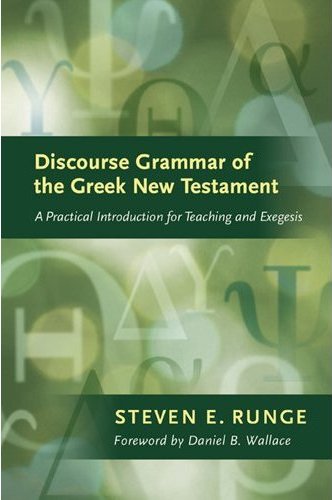
Discourse Grammar of the Greek New Testament

I have never been this excited to read a book on Greek.  It is my new book soulmate (yes, books have souls).  If you know anything of Greek, do pick this book up.  Maybe a review will come some day.

Monday, April 18, 2011

And....

Today I'm finding out the gender of our baby.  This is just nuts.

Monday, March 21, 2011

(Almost) Free (Michael F.) Bird

(

There's a March sale over at cbd.com, where you can nab Michael Bird's 'Are You the One Who Is to Come?' for a sweet price of $3.99.  This book is a fascinating read where its depth and scope go beyond its length (208 pages).

I'm sort of offended that you're still reading this post; you should've bought 4 copies of the book by now.

Wednesday, March 16, 2011

Ministry Mental-Myopia

Question to self: Am I too limited mentally to do effective ministry?

Allow me to begin with a confession.

'My name is Kevin, and I am an ISTJ.'


This is me (some nuancing required).

I went to a meeting for the church elders, and to put it frankly: I didn't fit in.

I don't have the ability to think outside the box on big issues.  I can't consider all the issues that goes into making good decisions for the health and needs of the church that haven't already been laid out with an appended pros and cons chart.  Thinking about creative ways in reaching our local context--not a chance, 'cause I need about 15 hours to think about the different social and ethnic groups in our local context (which will take me about 3 hours to finally settle on an adequate definition of what that means!).  And I haven't even gotten to money matters!

I cannot conceptualize a grand vision and three action steps to get the ball rolling.  I didn't even know something had to be changed!  Everyone else's ideas were machine gunning out, while my ideas were flopping out like a broken rubber band.  My mind is too slow and I get hung up on irrelevant side issues.  In terms of ministry production, I'm dial-up in a 4G world.

So what can I do?  More specifically, what good can I do?  What can I do if i can't create, or reason through possible ministry ventures?

Monday, March 14, 2011

Matthew, the Mount and Treasure

Matthew 6:19-21--Storing up treasure


This passage is certainly on the go-to list for a Christian perspective of money and material goods.  If the passage comes up in a Bible study or a casual Christian conversation, I'm sure the majority of those present will explain it in terms like "focus on kingdom values, not earthly" or "use your money for God things, not me things."  Well and good.


Yet, I am curious as to whether this understanding best fits the context in which Jesus says this.  As is well-known, Jesus speaks this Sermon on the Mount (whether he advertised it as such, we do not know) to those who joined themselves to his movement (the 12 disciples), as well as the people sitting around overhearing it.  So I wonder: How would they have understood his summons to abandon storing up "treasures on earth" (that is, money and nice possessions) and instead relocate them to heaven?  I wonder about this because although the text does not comment on the income levels of the people present, I'm going to assume it is not much because Jesus didn't seem to interact too often with the cultural elite. And we do hear the disciples say elsewhere that they have given up all they have to follow him, and they're the ones Jesus is primarily speaking to.  So what "treasure" do they have to store up?

So I wonder if taking into account the financial situation of the people present may lead us to a more suitable understanding of Jesus' teaching here.  I don't know what that will look like; it may be more like a facelift than total reconstructive surgery, who knows.