Sunday, August 5, 2012

Interrogating the Word

When a believer comes to the Bible, she has questions in her mind that she would like answered. That is inevitable. Christians profess that the Bible has authority, that God speaks in and through it. So, whether consciously or sub-, the reader has expectations of the Bible that they desire God to fulfill. But what is the right question to ask? In my mind, the question many are trained to ask is "how am I saved?" So in any passage, be it in Numbers, the Gospels or Galatians, there is a salvific angst pressed upon the book by the reader and this question he/she has been taught to ask. Is this question good/bad/helpful? What other questions do you see others asking? What about yourself and your own scriptural interrogations?

Sunday, February 5, 2012

Review: The Gospel of John

Check out my review of J. Ramsey Michaels' "The Gospel of John" over at amazon.com

Check it out

Monday, January 16, 2012

Theological Ethics: A Mustard Seed Approach

"God is light, and in Him is no un-Christlikeness"--Graham Cole

Take a few of Paul's commands to the church in Rome: "Love must be sincere.  Hate what is evil; cling to what is good" (12:9); "Do not repay anyone evil for evil; respect what is right in the sight of all men.  If possible, so far as it depends on you, be at peace with all men" (12:17-18).

Do God and Jesus adhere to these ethical commands?*  Is it odd to consider that God himself clings to good, doesn't meet evildoers with evil and seeks peace with his creation?  Or that Jesus loved sincerely and did what was right in the sight of men? (I find that last bit especially interesting).

*I'm sorry I left out the Holy Spirit.  I'll try to make it up to him in a later post.

Sunday, January 1, 2012

Review: Luke


The Zondervan Exegetical Commentary series is well underway, with the publication of James, Galatians, Matthew, Ephesians and now Luke joining the number. This volume follows the vision of the series with the focus on accessible Greek language examination/translation and theological discussion in the commentary, and with an application section that concludes each section.

David Garland works through Luke largely by means of literary criticism (akin to Osborne's work on Matthew). He observes differences between the gospels, but seldom takes time to expound or explain them (unlike Bock; however, see his discussion on the divorce logion in Lk 16:18). Depending on the section, he works verse-by-verse and comments concisely on important Greek words (sans transliteration!). He includes relevant Jewish and Greco-Roman writings to help seat Luke's account of Jesus inside its first-century world, and he isn't afraid to look to Acts when explaining Luke.

While all of this sounds like standard fare for a commentary, it is done exceptionally well by Garland. While not a Luke specialist per se, he is a commentary specialist--with commentaries on Mark, 1 Corinthians and Colossians/Philemon under his belt. As a result, his writing is clear and concise, and his prose often sparkles with clever turns of phrase. This is most evident in the application sections, where he encourages care for the needy or speaks on divorce with pastoral sensitivity.

Depending on what one needs in a commentary, this one-volume work is a great foundation for studying and preaching on Luke. Up-to-date, academically informed and pastorally sensitive--it is well worth having.

(This is verbatim my review posted on Amazon.com)

Tuesday, November 22, 2011

Word...

Will there be sarcasm in heaven?  And how does that affect our use of sarcasm now?

Tuesday, November 1, 2011

Lord's Supper Homily

Here's a brief homily I used to introduce the Lord's Supper on Sunday:

The cross is seen as the main symbol of Christianity, and rightly so.  The cross clearly symbolizes Jesus' suffering and death, which is essential for faith and the gospel.  Unfortunately, the other important symbols--the bread and the cup--can be easily downplayed or totally ignored.  However, we cannot overlook them because Jesus used the bread and the cup to interpret and explain his death.  Jesus did not die as an inspirational martyr under a corrupt system; he died for us.  "This is my body given for you."  And his blood was not shed to display his guilt as a lawbreaker; it was shed to begin a new covenant--a new relationship between us and God--that manifests itself in the forgiveness of sin.  "This cup is the new covenant in my blood, for the forgiveness of sins."  Thus we see that Jesus' death isn't the end of a life, but the beginning of a new relationship between God and those who trust in him.  So let us honor and celebrate his death by taking the bread and the cup.

Wednesday, June 22, 2011

What is a Systematic Theologian?

“The systematic theologian: a lamentable creature, whose reach exceeds his grasp, responsibility outdistances his competence; he is dependent on the Bible as his foundation, yet he lacks the exegete’s mastery of the language, textual intricacies and historical backgrounds. He can only aspire to the analytic rigor of philosophers. Historians shake their heads in dismay at his hasty generalizations, and longsuffering social scientists wait for him to say something relevant.”


-Kevin Vanhoozer

Wednesday, June 8, 2011

Napoleon Won


We're nearing the 7th anniversary of the release of Napoleon Dynamite, in my opinion a third-rate comedy stuck in first gear for eighty-two minutes, yet it still managed to suck in an undeserving $47 million (thanks IMDB).  Since the movie challenges Star Wars and The Sandlot in the realm of pop culture ubiquity, a plot recap would be both hopelessly redundant and borderline nonsensical because there is no plot (thus also challenging Seinfeld's title of "the show about nothing").

In case my tone was not accurately conveyed in the above paragraph, let me be explicit: I did not like Napoleon Dynamite.  But that's not the point of this post, so put down your stones; I am writing to admit to something else.  Over the past few days I watched little bits of several different "comedy" films on Netflix Instant Watch, and I started asking the question that I often default to: What inspired this?  I enjoy discovering the origins and beginnings of things, so I turned my mental gaze to the origins/inspiration behind these films I watched.  And time after weary time, no matter how much I tried to shake the thought like a leech on my back, I had to honestly conclude:

Napoleon Dynamite is the most influential comedy of my generation

As much as ND draws on other comedy traditions (especially 80s romantic comedies), ND is in a class by itself.  No film before it had a cast made up of entirely awkward characters.  No film before it had more "awkard" scenes and dialogue than ND.  And now, most films and TV shows thrive on the Dynamite approach (pardon the pun) to less jokes and more "weird."

So I witness to Napoleon Dynamite's cultural influence, as much as I want to persist.  Napoleon, you win.

Wednesday, May 18, 2011

Book sale @ Text, Community & Mission

The ever-illuminating Daniel J. Doleys is selling more books than your grandfather's garage could handle.  And all of the prices are about the cost of books circa 1955, so get over there now

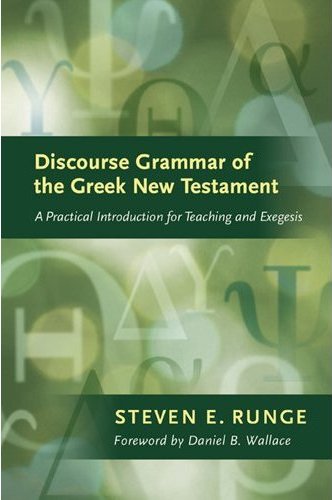
Discourse Grammar of the Greek New Testament

I have never been this excited to read a book on Greek.  It is my new book soulmate (yes, books have souls).  If you know anything of Greek, do pick this book up.  Maybe a review will come some day.

Monday, April 18, 2011

And....

Today I'm finding out the gender of our baby.  This is just nuts.

Monday, March 21, 2011

(Almost) Free (Michael F.) Bird

(

There's a March sale over at cbd.com, where you can nab Michael Bird's 'Are You the One Who Is to Come?' for a sweet price of $3.99.  This book is a fascinating read where its depth and scope go beyond its length (208 pages).

I'm sort of offended that you're still reading this post; you should've bought 4 copies of the book by now.

Wednesday, March 16, 2011

Ministry Mental-Myopia

Question to self: Am I too limited mentally to do effective ministry?

Allow me to begin with a confession.

'My name is Kevin, and I am an ISTJ.'


This is me (some nuancing required).

I went to a meeting for the church elders, and to put it frankly: I didn't fit in.

I don't have the ability to think outside the box on big issues.  I can't consider all the issues that goes into making good decisions for the health and needs of the church that haven't already been laid out with an appended pros and cons chart.  Thinking about creative ways in reaching our local context--not a chance, 'cause I need about 15 hours to think about the different social and ethnic groups in our local context (which will take me about 3 hours to finally settle on an adequate definition of what that means!).  And I haven't even gotten to money matters!

I cannot conceptualize a grand vision and three action steps to get the ball rolling.  I didn't even know something had to be changed!  Everyone else's ideas were machine gunning out, while my ideas were flopping out like a broken rubber band.  My mind is too slow and I get hung up on irrelevant side issues.  In terms of ministry production, I'm dial-up in a 4G world.

So what can I do?  More specifically, what good can I do?  What can I do if i can't create, or reason through possible ministry ventures?

Monday, March 14, 2011

Matthew, the Mount and Treasure

Matthew 6:19-21--Storing up treasure


This passage is certainly on the go-to list for a Christian perspective of money and material goods.  If the passage comes up in a Bible study or a casual Christian conversation, I'm sure the majority of those present will explain it in terms like "focus on kingdom values, not earthly" or "use your money for God things, not me things."  Well and good.


Yet, I am curious as to whether this understanding best fits the context in which Jesus says this.  As is well-known, Jesus speaks this Sermon on the Mount (whether he advertised it as such, we do not know) to those who joined themselves to his movement (the 12 disciples), as well as the people sitting around overhearing it.  So I wonder: How would they have understood his summons to abandon storing up "treasures on earth" (that is, money and nice possessions) and instead relocate them to heaven?  I wonder about this because although the text does not comment on the income levels of the people present, I'm going to assume it is not much because Jesus didn't seem to interact too often with the cultural elite. And we do hear the disciples say elsewhere that they have given up all they have to follow him, and they're the ones Jesus is primarily speaking to.  So what "treasure" do they have to store up?

So I wonder if taking into account the financial situation of the people present may lead us to a more suitable understanding of Jesus' teaching here.  I don't know what that will look like; it may be more like a facelift than total reconstructive surgery, who knows.

Sunday, March 6, 2011

Abuse of Scrutiny

I am a critic, firm and critical.  But I am not the good kind.  I am a prideful critic.

When it comes to Bible-y things, I assume I know lots.  And not only lots of facts, but lots of answers.  So when other people try to speak about things within my realm of knowledge, I don't consider their ideas valid, but see them as guilty until proven innocent, intellectually intenable until conceptually possible.  It's a hostile defense mechanism established under my self-aggrandizing regime.  The thoughts are of others are immediately held suspect, tortured, interrogated and released with cold indifference, if realeased at all.  It seems as though grace has not penetrated my sphere of intellectual property, since I worked hard to acquire this monopoly on biblical and theological truth [roll eyes now].  While on occasion a refreshing spirit of humility and charity may descend from on high, too often I labor as a temple without The Presence, a person that loves self with heart-soul-mind, but doesn't reciprocate that love to others because I am not loving the LORD first.

Saturday, January 15, 2011

Good quote

JETS June 1, 1984, page 245, Daniel Schibler's review of Carl Armerding's The Old Testament and Criticism:   'May this book contribute to end the sad phenomenon of many evangelicals--viz., using scripture like a drunk would a lamppost: for support rather than for illumination.'

How does this quote hit you?

Tuesday, January 11, 2011

'Jesus the Temple' Review


Nicholas Perrin's 'Jesus the Temple' is a helpful and thought-provoking book that investigates how Jesus and the early Christian movement related to the Jerusalem temple.  The book sets up the discussion by taking passages from Paul and other early Christian writers where language of the temple is used (1 Cor 3:9-11; 6:16, 19-20), of which Perrin asks where the source of this 'Temple identity' came from.  His answer is Jesus, which he seeks to demonstrate by spending the next 185 pages arguing that Jesus' actions and teachings constituted an alternative temple movement.

For its small size (190 pages +32 pages of references and indices), this book covers a lot of ground.  Perrin sets this book in the midst of debates about the historical Jesus and his relation to Paul and the other New Testament writers (what did Paul know of Jesus?  What continuity is there between Jesus' teachings and the rest of the NT?).  However, the bulk of the book (three of the five chapters) is devoted to Jesus' words and deeds that (in Perrin's mind) ought to be seen as 'Temple acts' (my words, not his).  Let me allow Perrin to speak for himself: "Jesus of Nazareth's most distinctive activities, healings/exorcisms, and meals were public signs that he had reconstituted time, space, and a people around himself, the new convergence of heaven and earth, the new temple" (p 179).

To this reviewer, the most illuminating discussion was on the topic of Jesus and the poor (chapter 4).  Here, Perrin treats the thorny issues of Jesus' teachings on money (the rich young ruler incident, etc.) and how they relate to his temple program.  While trying not to gush too much, I urge scholars and pastors (if I must dichotomize the two) to wrestle with Perrin's understanding of Jesus' poverty ethics. He seeks to go beyond the social justice vs. spiritualizing antithesis, which helps provide a more nuanced understanding of Jesus' view of riches and poverty.

Lastly, historical Jesus scholarship is blessed with not only gifted scholars, but gifted writers as well.  Perrin joins this enviable group, with his consistently clever turns of phrase and penchant for illustrations.  Occasionally his style would impede the clarity of the discussion, but on the whole his style made this book a delight to read and engage with.

Perrin has provided New Testament readers with a fresh perspective on the mission of Jesus that does justice to material in the four gospels.  Those interested in the historical Jesus, New Testament theology, and Jesus' ethics will find plenty of thought-provoking insights here. I hope this book would be widely received, and I cannot wait for the follow up volumes from Perrin.

(NOTE: This was a copy of the review I posted on Amazon.  I'm looking to interact with this book more in later posts)

Saturday, November 13, 2010

Thomas Schreiner's Galatians


So it's finally here, Schreiner's commentary on Galatians in the Zondervan Exegetical Commentary on the New Testament series (ZECNT). With a sermon on Gal 4:21-31 coming up, I immediately put this to work. Here are some of my scattered thoughts about the commentary:

1) Very stylish cover and page layout (I'm not bothered by the small margins). There are on average five footnotes per page (often more), where he interacts with specific authors on grammatical/historical points. There are a few excurses on the obvious Galatians flashpoints (justification, works of law, faith in/of Christ, Lev 18:5, law of Christ, Israel of God).

2) For the introduction, three sentences are given to authorship, six pages to the letter recipients (prefers a South Galatia readership), five pages to the situation Paul is addressing, three pages on the issue of empire in Galatians, and sixteen pages on the opponents' background and beliefs (Jewish? Pagan? Etc.). Other issues are addressed as well, but these were the most interesting to me.

3)I'm not a 'Paul guy,' but the bibliography and author index seem pretty well-rounded to me, although Campbell's The Deliverance of God is a surprising omission.

4)The frequent text boxes, shaded areas, and clear divisions help the reader track the discussion. The graphical layout and structural outline of the text do a great job at tracking the argument, which is essential for a letter like Galatians.

5) The concluding "Theology in Application" sections were often helpful, while not overly stimulating.

6) When talking about Greek, very little jargon is used (I couldn't find any "epexegetical, resumptive, protasis-apodosis, etc."), and any jargon used is explained, ex. "adversative conjunction 'but'" (p. 348).

8) The closing 'Themes in Galatians' contains great summaries on....themes...in Galatians.  You see, there's that emphasis on clarity this series holds to.

7) I'd compare this with the BECNT series.  While ZECNT may not be as detailed as BECNT, it matches it with clarity and a holistic approach.  And the theology/application emphasis in ZECNT isn't found in BECNT or even Pillar.

My impression: The focus on the flow of the argument (which the series obviously strives for) is commendable and Schreiner does it well. While some will surely miss in-depth, scholarly discussion on every individual word, Schreiner gives you Galatians as a whole. Pastors would do well to pick this up, and scholars would do badly to pass it by.

Wednesday, October 20, 2010

2 Maccabees reflection--almost

So what does one do when they fail to complete an academic writing assignment? Throw it up on a blog! And so I follow this rule that I just made up.

This was supposed to be a reflection on 2 Maccabees, but the deadline was a little to quick for my writing habits. Yet, instead of locking this up in a mausoleum, I set it free on the net. So here it is.

Perhaps the most emotionally gripping passage in 2 Maccabees is chapter seven with the persecution of the mother and her seven sons. Yet, in the midst of the vivid descriptions of the barbarous torture of the family, the theological theme of atoning martyrdom is brought up. While the references to atoning martyrdom in this passage are brief, I will argue that the concept arose out of the Jewish experience of persecution and the defilement of the temple. In this brief reflection the first part will examine the material in 2 Maccabees (especially chs. 5-7), and then conclude with a discussion of the role of atoning martyrdom with Jesus in the New Testament gospels.
The context for the development of atoning martyrdom begins in 2 Maccabees 5 with the invasion of wrathful Antiochus from Egypt to Jerusalem in 5:11. After his great slaughter, he, led by Menelaus, entered the temple and seized the temple vessels and votive offerings (5:16). While the text does not explicitly say, it can be reasonably inferred that this action caused the temple to be defiled. Following this, the narrative aside (5:17-20) makes it clear that the nation was under God’s judgment, which also implies that they were defiled because of sin.
Turning to 2 Maccabees 6, the Hellenistic culture is violently forced upon the Jewish nation. This includes the debauchery of the people in the temple, and the forbidden elements offered on the altar. If there was any question of the defilement of the temple from the previous chapter, it is obvious that the nation is defiled, thus rendering it unable to offer means of atonement for sin and purification.

End of text


Maybe someday I'll finish it, but I'm not holding out hope.

Sunday, June 27, 2010

Prefatory shots across the proverbial bow

1) The term "community" has been that itch in my upper-middle back that I can't reach. It annoys me. I don't know why it's there. Now, it probably is my Henry Roberts-esque inclination towards order and understanding, but I just want to know what the blessed word means. For all the times I've heard "we're a community of x" or "we're building more community through y and z," one part of me gives a vocal cheer while another gives a subconscious query. What is a community? How many communities can one be a part of? I'm not issuing a public moratorium of the term, but expressing my personal ignorance as to the term's significance and extension.

2) How do you meaningfully show appreciation for friends?

3) And now for the topic we've all been waiting for: Church. Question: Why do churches insist on creating new program after program, when other churches/ministries in the area may already have a similar program in place? Why not simply join forces in a particular ministry area. I see many advantages to this (and a few cons, naturally); so why isn't it done more?